


What is VOC?
Volatile Organic Compounds (VOC) are a class of organic chemicals that have high vapor pressure under ambient conditions. They easily evaporate and are commonly
found in waste, industrial processes, and biogas sources.
When released into the air, they undergo chemical reactions in the atmosphere, leading to the formation of ozone and other harmful compounds. This reduces air quality, negatively affects human health, and causes operational problems within facilities such as equipment corrosion, sensor malfunctions, and safety risks.
When released into the air, they undergo chemical reactions in the atmosphere, leading to the formation of ozone and other harmful compounds. This reduces air quality, negatively affects human health, and causes operational problems within facilities such as equipment corrosion, sensor malfunctions, and safety risks.
Benefits of VOC Removal
VOC removal provides significant environmental and operational advantages. Eliminating volatile organic compounds reduces air pollution and harmful emissions,
thereby protecting the environment and human health. At the same time, it prevents safety issues such as corrosion, contamination, and explosion risks in production
facilities, extending equipment life and improving operational continuity. Keeping VOC emissions within legal limits ensures regulatory compliance and helps avoid
potential fines or sanctions. In this regard, VOC removal is a critical practice for maintaining both safe and sustainable operations.
Negative Effects of VOC
VOC reduce system performance and cause serious damage to critical equipment:
Membranes: Clogging and reduced service life
PSA Systems: Decreased separation efficiency and increased energy consumption
Activated Carbon Beds: Rapid saturation and frequent media replacement
Sensor and Equipment Failures: Pollutants interfere with the accurate operation of pressure, flow, and gas quality sensors, leading to incorrect measurements and unexpected system shutdowns.
Grid Injection Risk in RNG Projects: Insufficiently treated RNG may fail to meet grid quality standards, resulting in rejection or financial penalties.
Catalyst Poisoning: VOC damage downstream purification and upgrading units such as membranes and catalytic converters.
Membranes: Clogging and reduced service life
PSA Systems: Decreased separation efficiency and increased energy consumption
Activated Carbon Beds: Rapid saturation and frequent media replacement
Sensor and Equipment Failures: Pollutants interfere with the accurate operation of pressure, flow, and gas quality sensors, leading to incorrect measurements and unexpected system shutdowns.
Grid Injection Risk in RNG Projects: Insufficiently treated RNG may fail to meet grid quality standards, resulting in rejection or financial penalties.
Catalyst Poisoning: VOC damage downstream purification and upgrading units such as membranes and catalytic converters.
Our Solution
The VOC Removal System (SGS), which initially started as an R&D project supported by the Ministry of Industry, has evolved into a regenerative system that
eliminates the need for continuous gas analysis and ensures the uninterrupted supply of fuel classified as clean gas. The selective properties of the filter
materials used in the VOC Removal System enable both highly effective purification and the prevention of impractical requirements such as continuous analysis
and frequent media replacement. Thanks to its modular design, the system can be easily scaled to any capacity, and its very low pressure drop is a key factor
for long-term energy savings.
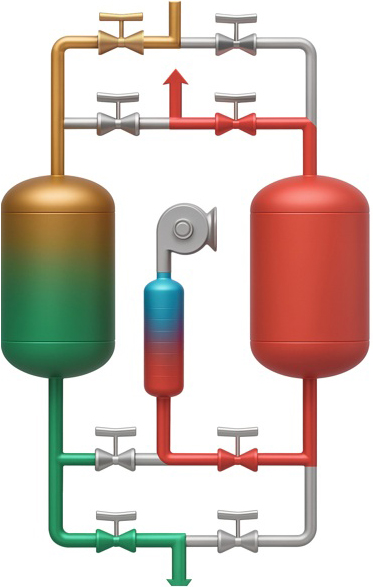
The ANKA VOC Removal System basically consists of two tanks containing the filter media used for VOC removal. These tanks operate alternately. When the VOC removal capacity of one tank is saturated, the system automatically switches to the other tank, while the saturated tank is regenerated and made ready for reuse. In this way, clean gas is supplied to the engines continuously and without interruption.
The VOC Removal System achieves 100% success in meeting the performance criteria specified by engine manufacturers for the purification of gas streams with high contaminant loads, such as landfill gas, and guarantees the continuity of these criteria based on both treated gas and oil analysis results.
The key advantages of the ANKA VOC Removal System include predefined media replacement intervals with guaranteed performance based on both gas and oil analyses, no additional labor requirement for the facility throughout system operation, uninterrupted purification performance, and a modular design that allows the system to be manufactured according to specific customer needs.
The ANKA VOC Removal System basically consists of two tanks containing the filter media used for VOC removal. These tanks operate alternately. When the VOC removal capacity of one tank is saturated, the system automatically switches to the other tank, while the saturated tank is regenerated and made ready for reuse. In this way, clean gas is supplied to the engines continuously and without interruption.
The VOC Removal System achieves 100% success in meeting the performance criteria specified by engine manufacturers for the purification of gas streams with high contaminant loads, such as landfill gas, and guarantees the continuity of these criteria based on both treated gas and oil analysis results.
The key advantages of the ANKA VOC Removal System include predefined media replacement intervals with guaranteed performance based on both gas and oil analyses, no additional labor requirement for the facility throughout system operation, uninterrupted purification performance, and a modular design that allows the system to be manufactured according to specific customer needs.
PRODUCT FEATURES
- Fully automatic operation via PLC with no operator intervention required
- Dedicated safety PLC for system protection
- Additional sensors and safety relief valves for enhanced system safety
- Low maintenance cost
- Compliance with ATEX and CE directives
- Fail-safe system design
Our Product Portfolio
| Model | Approx. Dimensions | Max. Gas Capacity | Approx. Weight |
|---|---|---|---|
| SGS-300 | 1.9m E x 3.5 m B x 3.6m Y | 300 Nm3/h | 1200 kg |
| SGS-700 | 2.1m E x 4.2m B x 4.6m Y | 700 Nm3/h | 2200 kg |
| SGS-1400 | 2.3m E x 4.5m B x 4.9m Y | 1400 Nm3/h | 3100 kg |
| SGS-2800 | 2.5m E x 4.9m B x 5.5m Y | 2800 Nm3/h | 5300 kg |
| SGS-5000 | 4.6m E x 6m B x 6.3m Y | 5000 Nm3/h | 7800 kg |
Economic Gains and Savings
By installing Regenerative VOC Removal Systems in your facilities, you can achieve cost savings across multiple expense categories.
-


MAINTENANCE
Overall maintenance costs
Up to70% -


SPARE PART
Spare parts replacement costs
Up to85% -


PRODUCTION LOSS
Production loss during the head reconditioning and unexpected failures causing stoppage
Up to90% -


POWER LOSS
Energy loss caused by contamination
Up to95%